Research Project on Relationship Between Accounting Information Systems and Corporate Decision Making
An empirical study testing whether AIS adoption affects capital structure, using ERP implementation across six ASX-listed industrial companies.
The brief
An empirical study of whether accounting information systems influence corporate financial decision-making, framed through Contingency Theory — the position that an AIS is effective only insofar as it fits the organisation's size, structure and strategy.
Built a panel of 30 firm-year observations (2019–2023) from six ASX-listed industrial companies: ALS, Cleanaway, SGH, IPH, Monadelphous and Worley. AIS adoption was proxied as a dummy variable for ERP implementation, identified through a manual keyword search of annual reports, and tested against leverage with controls for firm size, ROA, asset turnover, net profit margin and firm age.
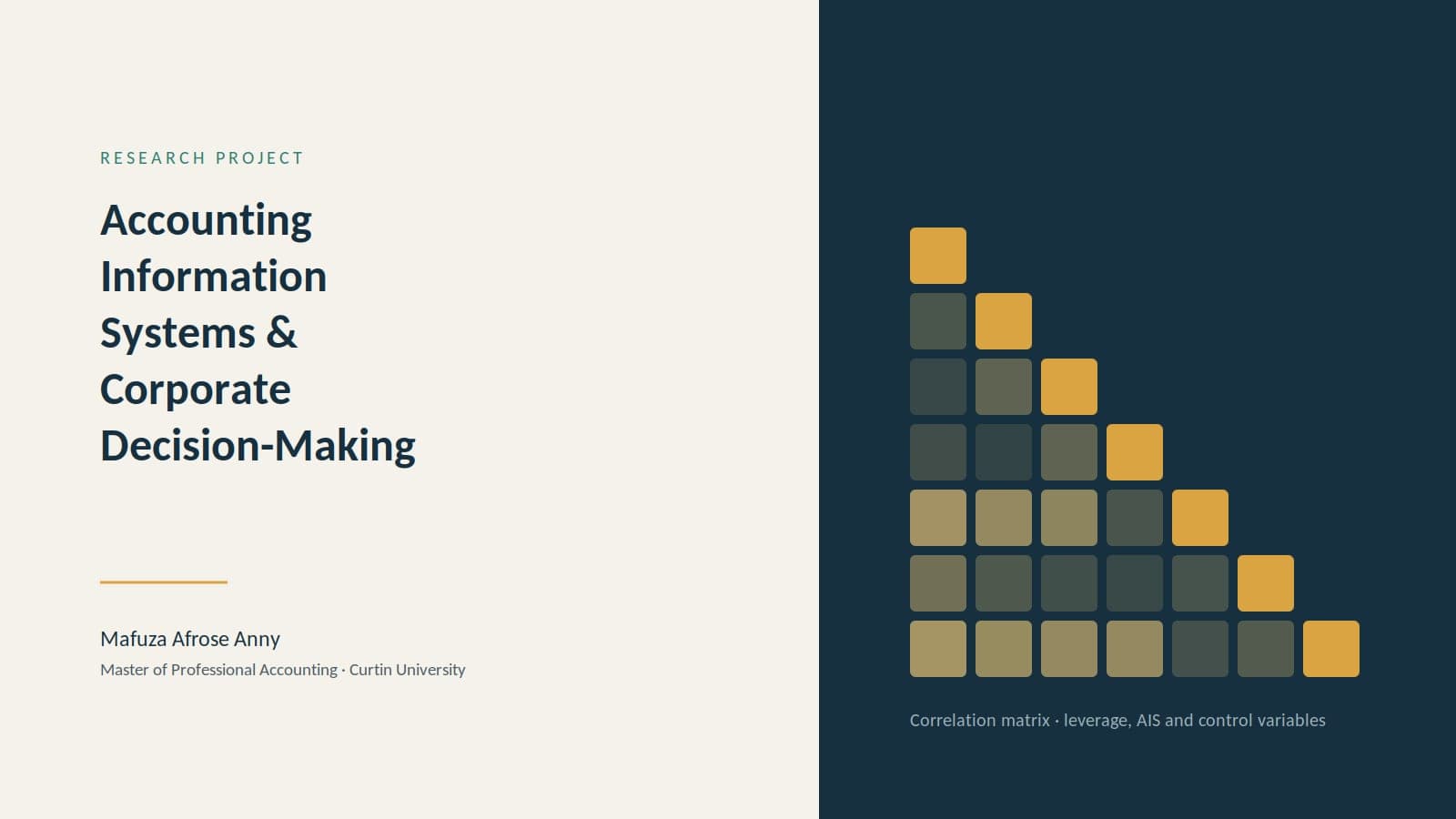
The regression explained 52% of the variance in leverage and was significant overall (F = 4.17, p = 0.01), but the AIS coefficient itself was not significant (β = 0.01, p = 0.88). Asset turnover showed the strongest relationship with leverage (–0.62 correlation), suggesting firms using assets efficiently rely less on external debt. The finding is consistent with Contingency Theory: AIS adoption alone doesn't shift capital structure — what matters is how it is integrated into strategy.
Skills: Panel data construction · Multiple regression · Correlation and descriptive analysis · Academic literature review